Hazardous Waste Disposal in Sedona and the Verde Valley 2026 Guide
Paint, fuel, batteries, fluorescent bulbs, pool chemicals and other hazardous household products do not belong in a dumpster or an ordinary junk-removal load. The hard part in the Verde Valley is that disposal options depend on three things: who generated the material, where that person lives and exactly what the product is.
This guide gives residents and businesses a practical, source-checked route for the most common problem materials in Sedona, Cottonwood, Camp Verde, Clarkdale, Jerome, Cornville, Rimrock, Lake Montezuma, Village of Oak Creek and Verde Village.
Verified October 20, 2026. Call before driving. Store programs, fees, hours and acceptance rules can change. A phone confirmation is especially important for unusual items, large quantities and anything not in its original labeled container.
The short answer
As of this review, we could not verify a comprehensive, public, year-round household hazardous waste drop-off facility in Yavapai County. Most Verde Valley households need to match each item to a specific local option: auto-parts stores for used oil and vehicle batteries, permanent medication drop boxes, retailer programs for certain batteries and bulbs, and county facilities for a limited list of materials. The item-by-item guide below shows the best verified starting point for each common product.
Coconino County residents have a different option: the Flagstaff Hazardous Products Center operates year-round for City of Flagstaff and Coconino County residents who meet its identification requirements. Sedona spans both Yavapai and Coconino counties, so a Sedona resident’s county matters.
Commercial waste is a separate track. Household-style materials generated by offices, shops, contractors and other commercial operations are not automatically covered by the federal household hazardous waste exclusion. Businesses should start with ADEQ, determine their generator status and use an authorized transporter or receiving facility.
Choose the right disposal route
Yavapai County households: Start with the item-by-item guide below. Local options are split among retailers, permanent collection programs and county facilities; no single location accepts everything.
Coconino County households: The Flagstaff Hazardous Products Center is the most complete year-round option if your address meets its residency requirements.
Businesses, contractors, landlords and institutions: Skip household collection programs and go to the commercial-waste section. Generator rules apply based on who created the waste, not simply what the container looks like.
Verified local and regional disposal options
Flagstaff Hazardous Products Center
6770 E. Landfill Road, Flagstaff · Monday, Wednesday and Friday, 8 a.m.–4 p.m. · 928-213-2159
Comprehensive household hazardous-waste service for qualifying City of Flagstaff and Coconino County residents. ID and address verification are required. Published limits include a 5-gallon maximum container size, 20 liquid gallons per household per day and 200 pounds per month; drums, totes and tanks are not accepted.
Camp Verde Transfer Station
2600 E. Highway 260, Camp Verde · Tuesday–Saturday, 8 a.m.–4 p.m. · 928-713-8910
Accepts ordinary solid waste plus a limited list of special items, including used motor oil and vehicle batteries under the county’s posted fee schedule. This is not a comprehensive hazardous-waste facility. The county currently links to a fee sheet dated 2025, so confirm the current charge before driving.
Camp Verde Waste Tire Yard
2600 E. Highway 260, Camp Verde · Wednesday–Friday, 8 a.m.–4 p.m. · 928-713-2273
Accepts passenger and other waste tires. The currently linked county fee sheet is dated 2025; see the tire section below and call to confirm current fees and limits.
Cottonwood Transfer Station
1500 W. Mingus Avenue, Cottonwood · Monday–Saturday, 7 a.m.–5 p.m. · 928-531-0255
Accepts ordinary solid waste and bulky items. The city does not publish a hazardous-waste acceptance list for this site, so do not bring chemicals without direct confirmation.
Clarkdale Public Works battery drop-off
890 Main Street, Clarkdale · 928-639-2450
The town lists alkaline, lithium-ion, NiCd, NiMH, silver-button and other dry-cell batteries. Its page does not state eligibility or drop-off hours, so call before visiting.
O’Reilly Auto Parts recycling
Free oil, fluid, filter and battery recycling is available for household or do-it-yourself quantities. Local stores are at 833 S. Main Street in Cottonwood, 928-634-0524; 1016 W. Finnie Flat Road in Camp Verde, 928-202-3627; and 166B Coffee Pot Drive in Sedona, 928-282-8702. Keep fluids separate and call the chosen store to confirm its quantity and container rules.
Cottonwood Home Depot recycling
1030 S. State Route 260, Cottonwood · 928-649-3758
The store directly confirmed on September 15, 2026 that it accepts intact CFLs. It does not accept linear fluorescent tubes or broken bulbs. Home Depot’s published program also accepts qualifying rechargeable batteries, generally up to 11 pounds and under 300 Wh. Call before bringing an unusual battery or a large quantity.
MATFORCE medication drop boxes
Permanent drop boxes are available at several Verde Valley law-enforcement locations for unwanted prescription and over-the-counter medication. Call the selected location about lobby hours and excluded items. Sharps do not go in medication boxes.
A seasonal Sedona collection option
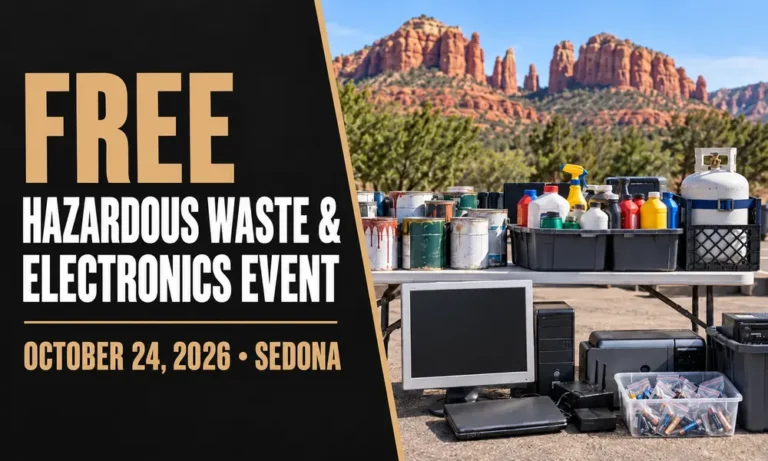
The City of Sedona, together with Yavapai County, is hosting its 8th Annual Household Hazardous Waste and Electronics Collection Event on Saturday, October 24, 2026, from 7:30 a.m. to 12 p.m. in the Sedona Red Rock High School parking lot, 995 Upper Red Rock Loop Road. It is a useful one-day, drive-through option for eligible households with items such as oil-based paint, fuels, household batteries, fluorescent bulbs, pool chemicals, standard grill and camping propane tanks and electronics. Residents may also bring medical waste (medications, vitamins and sharps; no controlled substances) and paper documents for shredding (the city sets a limit of four boxes per vehicle). Event partners are Clean Harbors, Westech Recyclers and Assured Document Destruction.
The city says the free event is for City of Sedona residents and residents of unincorporated Yavapai County, including Cornville, Rimrock, Lake Montezuma, Verde Village and Village of Oak Creek. Sedona residents who live in the Coconino County part of the city are welcome too, and they may also use the Flagstaff Hazardous Products Center year-round (928-213-2159). The published eligibility does not list Cottonwood, Camp Verde, Clarkdale or Jerome, so residents of those incorporated communities should call City of Sedona Sustainability at 928-203-5060 before planning to attend. Check the city’s event details and acceptance list before you go; the event does not accept commercial waste, latex or acrylic paint, motor oil, vehicle batteries, tires, refrigerant appliances, ammunition, fireworks, explosives, smoke detectors or compressed-gas cylinders other than propane.
Simple transport precautions
Keep products in their original labeled containers whenever possible. Never combine chemicals, and never use food or beverage containers. Keep lids closed, place containers upright in a sturdy plastic tote or box and secure the load so nothing tips during the drive. Call the receiving location before leaving home if the product is unlabeled, the container is damaged or you have more than a normal household quantity.
Never pour unwanted chemicals into a drain, septic system, gutter, dry wash or onto the ground. Never hide hazardous products in a trash bag, dumpster or transfer-station load.
Item-by-item disposal guide
Latex and acrylic paint
The City of Sedona instructs residents to mix unwanted water-based latex or acrylic paint with cat litter or sawdust, allow it to dry and then place the solidified paint in ordinary trash. Your trash company controls what it will collect, so confirm its preparation rule before setting out a large quantity.
For a small amount, allow the paint to harden in a protected, ventilated place away from children, pets, rain and ignition sources. For a larger amount, add an absorbent or commercial paint hardener in accordance with the product instructions. The paint must be fully solid—not skinned over with liquid underneath.
Do not use this method for oil-based paint, stain, lacquer, thinner or solvent.
Arizona is not one of PaintCare’s current program states, so residents should not expect the free statewide paint-store drop-off network available in participating states. PaintCare’s locator may still display independent sites in non-PaintCare states; verify any Arizona listing directly before traveling.
Oil-based paint, stain, varnish, lacquer, thinner and solvent
Keep these products sealed and separate. Do not evaporate them intentionally, pour them out or mix them into latex paint. The Flagstaff Hazardous Products Center is the year-round option for qualifying Coconino County residents. If no public program is available, contact a licensed hazardous-waste service.
For an unlabeled or deteriorated container, call the receiving program before transporting it. Do not open it to identify the contents by smell.
Used motor oil, transmission fluid, gear oil and oil filters
O’Reilly’s national recycling program expressly accepts used motor oil, transmission fluid, gear oil, oil filters and automotive batteries at its stores, and the company’s local store pages list recycling services at the Cottonwood, Camp Verde and Sedona locations. Call first for quantity and container rules.
The Yavapai County fee sheet currently linked from the county website—dated 2025—also lists used motor oil as a fee item at transfer stations. Confirm the current fee with the Camp Verde Transfer Station at 928-713-8910.
Keep oil separate from antifreeze, gasoline, solvents, water and other products. Mixing can make the load unrecyclable and may change how it is regulated. ADEQ prohibits dumping used oil into sewers or state waters, using it as a dust suppressant and disposing of it on land except through an approved facility.
Vehicle batteries
Use a verified auto-parts recycling program or the Camp Verde Transfer Station. O’Reilly advertises free automotive-battery recycling. The county’s currently posted fee sheet, dated 2025, lists car batteries as a fee item at transfer stations; confirm the fee before traveling.
Arizona law prohibits disposing of lead-acid batteries in landfills or by incineration.
Transport the battery upright, protect the terminals from short-circuiting and keep it inside a sturdy tray or box. Do not handle a cracked or leaking battery without professional guidance.
Alkaline, button and rechargeable household batteries
Use the option that matches the battery:
- Alkaline and button batteries: Clarkdale Public Works lists alkaline, silver-button and several dry-cell types; call about access and eligibility.
- Rechargeable batteries: Clarkdale Public Works and Home Depot’s Call2Recycle program are verified options. Home Depot’s published program is generally limited to rechargeable batteries weighing no more than 11 pounds and rated under 300 Wh.
- Damaged or swollen lithium batteries: do not place them in a retail collection bin or ordinary mail. Do not puncture them. Call the manufacturer or collection program for case-specific instructions.
Do not place lithium-ion batteries in curbside trash or recycling. EPA warns that they can cause fires in collection vehicles and material-recovery facilities. For undamaged loose cells, protect terminals with nonconductive tape or place each battery in its own plastic bag before transport.
Antifreeze
The Flagstaff center accepts antifreeze from qualifying Coconino County residents. We did not find a Verde Valley retailer that publicly confirms household antifreeze collection, so none is listed here. Yavapai County residents without access to a public collection date may need to contact a licensed hazardous-waste service.
Never pour antifreeze onto the ground, into a storm drain or into a septic system. Keep it separate from used oil and other fluids.
Gasoline, kerosene and diesel
The Flagstaff center’s waste chart is the controlling source for qualifying Coconino County residents. Yavapai County residents who cannot use a public collection date should contact a licensed hazardous-waste service and identify the exact fuel before asking for a quote.
Do not try to “revive” unknown or contaminated fuel, give it away without knowing its condition, burn it in an open fire or use it on weeds. Store it temporarily only in an approved, tightly closed fuel container away from heat and ignition sources. Call the receiving program before transporting fuel in a damaged container.
Propane cylinders and camping canisters
A propane supplier or cylinder-exchange program may accept a serviceable exchange cylinder, depending on its type and condition. Call first.
Never put a propane cylinder in trash, recycling, a dumpster or a transfer-station bin. Call the receiving program or a propane supplier before transporting a heavily corroded or damaged cylinder.
Fluorescent tubes, CFLs, ballasts and mercury devices
The Cottonwood Home Depot confirmed directly on September 15, 2026 that it accepts intact CFLs. Its program does not advertise linear fluorescent-tube collection. Call Home Depot at 928-649-3758 before bringing a large quantity or anything other than intact CFLs. For tubes or ballasts, contact an authorized collection program before traveling.
If a CFL or fluorescent tube breaks, follow EPA’s broken-bulb cleanup guidance: clear people and pets from the room, air it out, shut off forced-air heating or cooling, avoid vacuuming initially, collect fragments carefully and place the debris in a sealable container.
Older fluorescent-light ballasts manufactured before 1979 may contain PCBs. A ballast marked “No PCBs” is different from an unmarked older unit; do not open either one. A business or household with a large quantity should call ADEQ or an authorized contractor before transport.
Electronics, televisions and small appliances
Best Buy’s current recycling program accepts many electronics at most stores, with product-specific limits and fees that vary. The nearest full stores are in Prescott and Flagstaff. Check the official item list and select the store before driving; do not rely on a fixed television fee copied into an evergreen article.
Back up and erase personal data before surrendering a computer, phone, tablet or storage device. If a device contains a swollen or damaged lithium battery, call the recycler before transport.
Medications
Take-back is the preferred route. MATFORCE’s current Yavapai County page links a 14-location medication-drop-box directory. Verde Valley entries include:
Cottonwood Police Department
199 S. 6th Street, Cottonwood · 928-634-4246
Camp Verde Marshal’s Office
646 S. 1st Street, Camp Verde · 928-567-6621
Sedona Police Department
100 Roadrunner Drive, Sedona · 928-282-3100
Clarkdale Police Department
49 N. 9th Street, Clarkdale · 928-649-7700
Jerome Police Department
305 Main Street, Jerome · 928-634-8992
MATFORCE says the boxes accept expired or unwanted prescription and over-the-counter medications during normal business hours. Call the selected agency for current lobby hours and item restrictions.
For medicine that cannot go to a take-back location, follow FDA’s current disposal instructions, including its separate Flush List. Do not apply a blanket “flush nothing” or “trash everything” rule.
Household sharps
ADEQ’s medical sharps guidance allows households to use a purchased sharps container or a heavy-plastic or metal container. If using a household container, ADEQ instructs residents to secure the lid with heavy-duty tape, mark it “Do Not Recycle,” keep it out of recycling and fully encapsulate the sharps with quick-drying cement, plaster or similar material before placing the hardened container in solid waste.
Never place loose needles in trash or recycling, and never use a glass or clear container.
For rural households with an ongoing need, ADEQ currently lists four mail-back programs that provide their own approved containers and packaging: Republic Sharps Service at 855-737-7871, GRP at 800-207-0976, MED PRO at 866-402-7499 and Sharps, Inc. at 800-772-5657. These programs accept only the containers they supply. Confirm current pricing, availability and shipping instructions directly with the provider.
Businesses and healthcare facilities must follow separate biohazardous-medical-waste rules; the household method is not a business-disposal shortcut.
Pool chemicals, pesticides and household cleaners
Keep every product in its original labeled container. Never mix pool chlorine with acid, ammonia-containing cleaners or any unknown product. If no local public collection program is available, contact a licensed hazardous-waste service.
Follow the pesticide label. Do not automatically triple-rinse, puncture or trash a pesticide container unless the label and local receiving program instruct you to do so. For an old or unknown pesticide, the National Pesticide Information Center provides free assistance from trained pesticide specialists Monday through Friday at 800-858-7378. It can help identify a product and explain label information, but it does not replace local disposal authorization.
Tires
Yavapai County operates the Camp Verde Waste Tire Yard at 2600 E. Highway 260, phone 928-713-2273, open Wednesday through Friday from 8 a.m. to 4 p.m.
The county’s fee sheet currently linked online is dated 2025 and lists separate fees for passenger tires with and without wheels, off-road and semi tires and other tire categories, with a limited number of passenger tires accepted free each year.
Because the posted document is dated 2025, call to confirm the current fee, annual limit and whether a wheel must be removed.
Fire extinguishers and compressed-gas cylinders
For any cylinder not explicitly listed, contact the manufacturer, gas supplier or an authorized hazardous-waste company. Do not vent, puncture, cut or place a cylinder in a scrap-metal pile unless the receiving facility has provided a specific preparation procedure.
Ammunition, flares, fireworks and explosives
Call the non-emergency line for your local police, marshal, sheriff or fire department and ask for instructions; do not assume the agency accepts walk-ins.
For suspected dynamite, blasting caps, military ordnance, mining explosives or an unknown explosive device, do not touch, move, soak or transport it. Leave the area and call 911.
Smoke detectors
Many ionization smoke alarms contain a small sealed americium-241 source. The U.S. Nuclear Regulatory Commission says intact household alarms present very low risk and cites analysis supporting disposal in household trash, but local hauler and landfill rules still control.
Remove the replaceable battery, keep the alarm intact, check the label and manufacturer instructions for a return program, and confirm with your trash provider before disposal. Never dismantle, crush or burn an ionization alarm.
Asbestos-containing material
Do not disturb suspected asbestos to “see what it is.” Older floor tile and mastic, pipe insulation, sprayed ceiling texture, siding and roofing can contain asbestos, but appearance alone cannot confirm it. Use a qualified inspector or laboratory and plan the project before demolition.
ADEQ’s asbestos program says federal NESHAP requirements apply to demolitions and renovations of commercial, institutional, public, industrial and certain residential facilities. Inspection, notification, certified personnel and waste-shipment requirements depend on the type of facility, activity and amount of regulated material. The commonly cited 160-square-foot and 260-linear-foot thresholds are renovation thresholds for NESHAP-regulated facilities—not a universal DIY rule for every house.
Call ADEQ’s Asbestos Program at 602-771-2338 and the receiving landfill before work begins. Bella Junk Removal does not remove asbestos-containing material.
Lead-based paint and renovation debris
Homes built before 1978 may contain lead-based paint. EPA recommends testing and lead-safe work practices before disturbing painted surfaces.
The EPA’s DIY guidance says the Renovation, Repair and Painting Rule generally does not apply to homeowners working on their own home. It does apply to paid contractors performing covered work in pre-1978 housing and child-occupied facilities, and may apply to owners who rent part of the home, operate child care there or renovate houses for resale.
EPA says most residential renovation waste can go to a licensed solid-waste landfill when collected and sealed to control dust, but state and local disposal rules still apply. Use heavy plastic or bags, seal the waste, prevent dust release and confirm acceptance with the landfill. Do not put loose paint chips or lead dust in a junk-removal load.
Unknown chemicals found during an estate, eviction or garage cleanout
Do not open, smell, pour or combine an unknown product. Record any visible label and the approximate container size, then call the appropriate collection program to ask whether it can be accepted. For unlabeled, deteriorated or commercial-size containers, contact ADEQ or a hazardous-waste contractor for guidance before moving them.
When no local drop-off program fits
Use a verified product-specific program
Motor oil and automotive batteries have local auto-parts options. Tires have a county yard. Medication has permanent drop boxes. Rechargeable batteries and intact CFLs have qualifying retail programs. These programs solve many common disposal problems without waiting for a one-day event.
Use the Flagstaff center if your address qualifies
The Flagstaff Hazardous Products Center is free only for City of Flagstaff and Coconino County residents who meet its ID requirements. It is not a general Northern Arizona facility, and a Yavapai County address does not qualify merely because Flagstaff is the nearest center.
Store the material safely until the next authorized event
For a stable product in an intact original container, temporary storage may be better than illegal disposal. Keep it closed, upright and away from children, pets, heat and ignition. Never combine products to save space.
Pay for a licensed or authorized service
Mail-back programs and hazardous-waste contractors can be appropriate for rural households with no public route, but acceptance and shipping rules depend on the exact material. Never place a hazardous product into ordinary mail or parcel service without an approved program’s packaging and instructions.
Commercial and business hazardous waste
Household programs are not business programs
Household collection programs generally exclude commercial waste. EPA also notes that household-type waste from commercial facilities and office buildings is not covered by the household hazardous waste exclusion simply because the product resembles something used at home.
This affects contractors, auto shops, property managers, landlords, salons, restaurants, medical offices, short-term-rental operators and any other business discarding paint, solvents, chemicals, batteries, lamps, aerosols or contaminated materials.
Step 1: make a waste determination
ADEQ requires a business to determine whether each discarded material is hazardous when it becomes waste. Hazardous waste may be ignitable, corrosive, reactive, toxic or specifically listed under federal rules. The product label or safety data sheet can help, but it may not be enough; process knowledge or laboratory testing may be required.
Step 2: determine generator category
Arizona uses the federal generator framework:
Very Small Quantity Generator (VSQG): 100 kilograms (220 pounds) or less of non-acute hazardous waste in a calendar month. A business may not accumulate 1,000 kilograms or more on site and still use the VSQG provisions.
Small Quantity Generator (SQG): More than 100 kilograms but less than 1,000 kilograms of non-acute hazardous waste in a calendar month. The SQG on-site accumulation limit is 6,000 kilograms.
Large Quantity Generator (LQG): 1,000 kilograms (2,200 pounds) or more of non-acute hazardous waste in a calendar month. More extensive management, training, planning and reporting requirements apply.
A business also becomes subject to LQG requirements for acute waste if it generates or accumulates more than 1 kg of acute hazardous waste or more than 100 kg of acute spill residue, debris or soil in a calendar month. Do not estimate liquid waste from drum size alone; density matters.
Use ADEQ’s current hazardous-waste guidance and call Compliance Assistance at 602-771-4673 before deciding that a business is exempt or that a manifest, EPA ID or specific accumulation rule does not apply.
Step 3: separate universal waste and used oil correctly
Arizona’s universal-waste program can simplify management of batteries, lamps, mercury-containing equipment, aerosol cans and certain qualifying pesticides. It does not mean every pesticide or every damaged battery can automatically go into a universal-waste box. ADEQ’s current labeling guide lists the required waste-specific labels and a one-year accumulation limit.
Used oil follows a separate regulatory track. Label containers “Used Oil,” keep them in good condition, prevent leaks and never mix oil with solvents or other waste. A retail DIY oil program may refuse business-generated oil even when it accepts oil from residents.
Step 4: use an authorized service and keep documentation
The correct service depends on the waste profile, generator category, packaging and destination. Verified starting points include:
ADEQ Compliance Assistance · 602-771-4673
Use this state resource for hazardous-waste guidance. Confirm the business’s waste determination, generator status and required paperwork.
myDEQ Assistance · 602-771-4728
Provides help obtaining or managing an EPA identification number. Confirm whether the specific activity requires an ID.
Clean Earth Phoenix · 2844 W. Broadway Road, Phoenix · 602-276-7602
The Phoenix service center lists hazardous and universal waste, lab packs and transportation services. Confirm Verde Valley pickup availability, route timing, accepted waste and the full quote.
TransChem Environmental · Phoenix office · 602-334-4536
Lists Arizona hazardous- and medical-waste services and transportation. Confirm Verde Valley pickup, accepted waste, packaging and the full quote.
Flagstaff Hazardous Products Center · 928-213-2159
Its primary page currently says the small-business program is paused except for business e-waste. Confirm appointments and current business e-waste acceptance before traveling.
Listing a company is not an endorsement and does not establish that it will accept a particular waste or schedule a Verde Valley pickup. Ask for the transporter’s EPA ID, the receiving facility, packaging instructions, all charges and the records you will receive.
Illegal dumping and spill reporting
ADEQ’s Emergency Response Unit is 602-771-2330 or 800-234-5677. The federal National Response Center is 800-424-8802. Reporting requirements and reportable quantities depend on the substance, quantity, source and affected environment; there is no single universal “no threshold” rule for every amount reaching any waterway. For an immediate threat to life or property, call 911.
For suspected illegal dumping or a solid/hazardous-waste complaint, use ADEQ’s environmental complaint page or call 602-771-4673. Do not handle dumped containers merely to identify who left them.
Arizona’s criminal-littering statute carries an unusually serious commercial consequence. Under A.R.S. § 13-1603, a knowing violation is a class 6 felony when it involves more than 300 pounds or 100 cubic feet, or when it is done in any quantity for a commercial purpose. Noncommercial violations are classified according to the quantity, material and location; they are not automatically limited to a class 2 misdemeanor.
Separately, A.R.S. § 49-924 authorizes a civil penalty of up to $25,000 for each day of a violation of Arizona’s hazardous-waste-management article or a permit, rule or order issued under it. That statute is not a universal $25,000 penalty for every dumping violation, but it shows why a business should obtain regulatory guidance and use an authorized service.
What Bella Junk Removal can and cannot remove
Bella Junk Removal does not transport hazardous waste, chemicals, medical or biological waste, asbestos-containing material, wet paint or solvent, contaminated soil, ammunition, explosives or full propane tanks. Those exclusions match the company’s current published service information.
After hazardous products are identified and separated, Bella can handle the ordinary bulk of many estate cleanouts and garage cleanouts: furniture, appliances, electronics, household contents, boxes, tools and general clutter. If you are unsure whether an ordinary item can go on the truck, call or text (928) 395-6441 before the appointment.
Do not move an unknown chemical into a “hazard pile” for the crew. Identify and separate hazardous materials before the appointment.
Quick-reference phone list
Yavapai County transfer stations: 928-771-3183
Camp Verde Transfer Station: 928-713-8910
Camp Verde Waste Tire Yard: 928-713-2273
Cottonwood Transfer Station: 928-531-0255
Clarkdale battery drop-off: 928-639-2450
Cottonwood Home Depot CFL recycling: 928-649-3758
Flagstaff Hazardous Products Center: 928-213-2159
MATFORCE medication-drop-box program: 928-708-0100
National Pesticide Information Center: 800-858-7378
City of Sedona Sustainability: 928-203-5060
ADEQ hazardous-waste compliance and complaints: 602-771-4673
ADEQ myDEQ / EPA ID help: 602-771-4728
ADEQ Asbestos Program: 602-771-2338
ADEQ Emergency Response: 602-771-2330
National Response Center: 800-424-8802
Bella Junk Removal, call or text: (928) 395-6441.
Printable version you can take with you
If you would rather have this on paper than on your phone, we put together a one-page printable you can stick on the fridge or keep in the truck. It covers the collection event date and location, what is accepted, what is not, and the numbers to call before you load anything up. Download the color version, or grab the black and white version if you are printing at home and would rather not burn through color ink. Dates, hours, and accepted item lists change, so call the number printed on the sheet to confirm before you drive out.
Frequently asked questions
Is there a year-round household hazardous waste facility in Yavapai County?
We could not verify a comprehensive, public, year-round HHW drop-off facility in Yavapai County as of October 20, 2026. The county does operate transfer stations and tire yards that accept particular items, and retailers collect certain products. Coconino County residents can use Flagstaff’s year-round center.
Where can I take hazardous chemicals today?
If you have a qualifying Coconino County address, use the Flagstaff Hazardous Products Center during its published hours. In Yavapai County, use a product-specific program if one exists. Otherwise, safely store an intact, stable household product for an authorized event or arrange a licensed service. Do not take an unlisted chemical to a transfer station or retailer without confirmation.
Can latex paint go in the trash?
The City of Sedona instructs residents to add cat litter or sawdust, allow latex paint to dry and then place it in regular trash. Confirm your trash hauler’s preparation rule. This does not apply to oil-based paint, stain, lacquer, thinner or solvent.
What should I do with old gasoline?
Do not blend unknown old fuel into fresh fuel, pour it out or burn it in the open. Keep it in an approved container and contact an authorized collection program before transporting contaminated fuel, diesel or a damaged container.
What if I inherited a garage full of chemicals?
Do not open, smell or combine unknown containers. Record visible labels and container sizes, call the appropriate household program for accepted items, and use a hazardous-waste contractor for deteriorated, unlabeled or commercial-size containers.
Will Bella Junk Removal haul the chemicals with the rest of a cleanout?
No. Bella can remove the ordinary contents after hazardous materials have been identified and separated, but it does not transport hazardous waste, chemicals, wet paint, medical waste, asbestos, explosives or other published exclusions.
Primary sources and verification links
- City of Sedona — Waste Collection and 2026 Event
- Yavapai County — Solid Waste Division
- City of Flagstaff — Hazardous Products Center
- City of Cottonwood — Transfer Station
- Town of Clarkdale — Sanitation and Battery Recycling
- ADEQ — Household Hazardous Waste FAQs
- ADEQ — Hazardous Waste Management for Businesses
- ADEQ — Used Oil
- ADEQ — Medical Sharps Disposal
- ADEQ — Asbestos Program
- ADEQ — Environmental Complaints
- Arizona Legislature — A.R.S. § 13-1603 Criminal Littering or Polluting
- Arizona Legislature — A.R.S. § 49-924 Hazardous Waste Civil Penalties
- EPA — Household Hazardous Waste
- EPA — Hazardous Waste Generator Categories
- EPA — Lead-Safe Renovations for DIYers
- EPA — Cleaning Up a Broken CFL
- MATFORCE — Yavapai County Medication Drop Boxes
- FDA — Where and How to Dispose of Unused Medicines
- National Pesticide Information Center — Contact a Specialist
- PaintCare — Current Program States
- Home Depot — Current Consumer Recycling Guide
- O’Reilly — Free Oil, Fluid and Battery Recycling
This guide provides general disposal information, not legal, environmental or emergency-response advice. The receiving program, waste generator and applicable regulator determine whether a specific material can be accepted and how it must be handled.
Last verified: October 20, 2026. To report a changed local listing, contact Bella Junk Removal at (928) 395-6441.