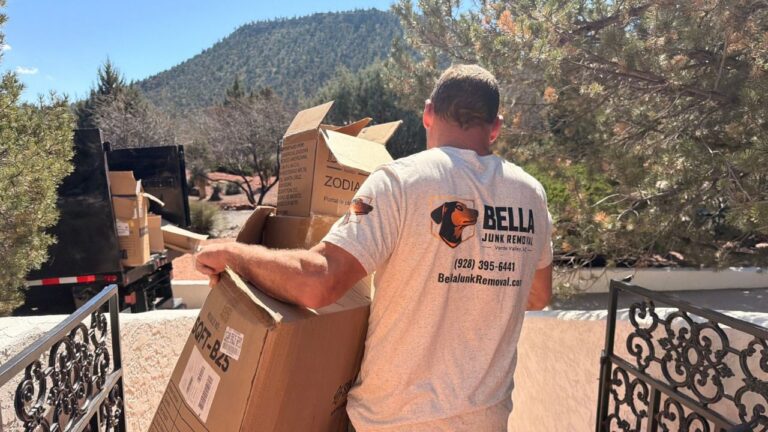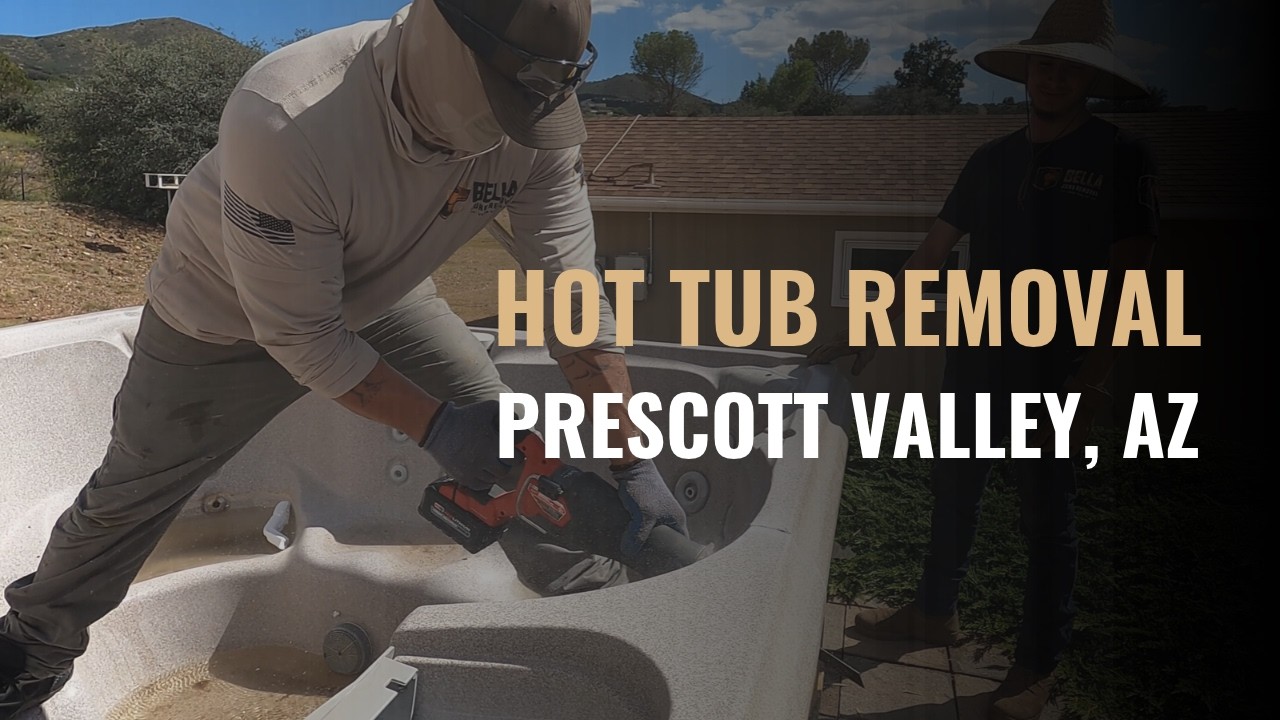
We cut up and hauled away a large hot tub in Prescott Valley this week. The homeowner had already disconnected the power, and the yard provided good access. Even then, the job required a reciprocating saw, a pry bar, and two people.
The hardest part wasn’t the hot tub. It was the cover.
If you have a hot tub sitting in the backyard that nobody has used since two summers ago, here is what removing it actually involves, whether you should attempt it yourself, and what to expect from the removal process.
For professional assistance, learn more about our hot tub removal service.
Why Hot Tubs Are Difficult to Remove
Hot tubs present several challenges that aren’t always obvious until the removal begins.
Hot Tubs Are Extremely Heavy
An empty midsize hot tub shell commonly weighs between 500 and 900 pounds. Larger models can weigh considerably more.
When filled with water, a hot tub can weigh thousands of pounds. Nobody should attempt to move one while it still contains water, so draining it is always the first step.
Hot Tubs Don’t Simply Come Apart
A hot tub consists of an acrylic shell reinforced with fiberglass, surrounded by foam insulation and supported by a wood or composite frame.
There usually isn’t a convenient set of bolts that allows the entire unit to be dismantled neatly.
Once the exterior panels and frame have been removed, the shell remains one large and awkward object. It may not fit inside a pickup bed, pass through a gate, or turn around a tight corner.
Disposal Is Part of the Job
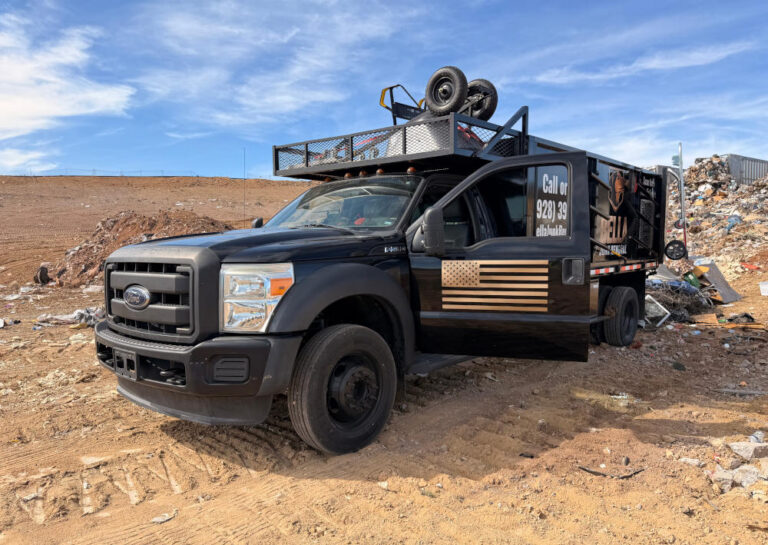
A nonworking hot tub generally has little resale value. Many disposal facilities will not accept one intact, and a complete shell will not fit inside a standard dumpster without first being cut into sections.
Planning where the material will go is an important part of the removal process.
Our guide to landfills and transfer stations in Northern Arizona provides information about disposal facilities serving Prescott Valley, the Verde Valley, and nearby communities.
The Waterlogged Cover Was the Hardest Part
On this Prescott Valley job, the hot tub cover was completely waterlogged. Our best estimate was that it weighed close to 200 pounds.
A dry hot tub cover may weigh around 50 pounds and can often be moved by one person. Once its foam core absorbs water, however, it can weigh two to four times as much.
It stops behaving like a lid and starts behaving like a soaked mattress with a hard shell. It flexes and shifts while you are trying to hold it, making it difficult to control.
This is one of the easiest ways for a do-it-yourself hot tub removal to result in a back injury.
How We Drained the Waterlogged Cover
Here is the technique we used:
- Punch several holes in the underside of the cover using a screwdriver or the tip of a saw blade.
- Stand the cover on its edge.
- Allow the trapped water to drain.
- Cut the cover in half if it is still too difficult to handle.
The cover was being discarded, so preserving it wasn’t necessary.
After approximately two minutes of draining, a cover that one person couldn’t move became manageable for two people.
Can You Remove a Hot Tub Yourself?
Sometimes.
A small hot tub with straight, open access may be a reasonable weekend project if you have:
- At least two physically capable people
- Appropriate cutting and lifting equipment
- A truck and trailer
- A disposal facility that will accept the material
- A safe and unobstructed route out of the yard
The project becomes considerably more difficult when:
- The hot tub must pass through a narrow gate
- The removal route includes tight corners or stairs
- The only exit crosses a finished patio
- The tub must be carried through part of the house
- The shell is built into a deck or enclosure
- You don’t have a way to transport hundreds of pounds of fiberglass and foam
- The electrical connection is still live
Electrical disconnection is not a judgment call. A qualified electrician should disconnect the power at the panel before anyone begins dismantling the hot tub.
How to Cut Up and Remove a Hot Tub
The exact process depends on the type of hot tub and the property’s access conditions. Most cut-up removals follow the same general sequence.
1. Drain the Hot Tub
Use a submersible pump or a garden-hose siphon to remove the water.
Plan carefully for where several hundred gallons of water will go. Do not discharge it into a neighbor’s yard or a natural wash, particularly if the water has recently been treated with chemicals.
2. Disconnect the Electricity
Have a qualified electrician disconnect the hot tub at the electrical panel before dismantling begins.
Turning off a nearby switch or control panel is not necessarily the same as completely disconnecting the electrical supply.
3. Remove and Drain the Cover
Remove the cover before working on the hot tub itself.
If the cover is waterlogged, puncture its underside, stand it on edge, and allow the trapped water to drain. Cut the cover into smaller sections if it remains too difficult to handle safely.
4. Remove the Exterior Panels
Take off the exterior panels to expose the frame, insulation, plumbing, and mechanical components.
Removing the panels also makes it easier to see how the tub is constructed and identify the safest places to begin cutting.
5. Remove the Mechanical Components
Remove the pump, heater, blower, accessible plumbing, wiring, and other components.
Taking these parts out reduces the weight of the remaining shell. Some of the metal components may also be suitable for recycling.
Our guide to recycling facilities in the Verde Valley and Northern Arizona includes nearby facilities that handle metal and other recyclable materials.
6. Cut the Shell Into Sections
A reciprocating saw fitted with a coarse demolition blade can cut through acrylic, fiberglass, and foam.
Cut the shell into sections that two people can safely carry and that will stack efficiently for transportation.
Wear appropriate protective equipment, including:
- Eye protection
- Work gloves
- Long sleeves
- An appropriate dust mask or respirator
Fiberglass dust is irritating and spreads easily throughout the work area.
7. Dismantle the Frame
Use a pry bar and reciprocating saw to break down the remaining wood or composite frame.
Watch for screws, nails, staples, wiring, and sharp pieces of plastic or fiberglass as the frame comes apart.
8. Clean the Area as You Work
Hot tub insulation is lightweight and can blow across a property surprisingly quickly.
Sweep and contain the foam throughout the job rather than waiting until the end. This helps prevent debris from reaching neighboring properties, landscaping, or swimming pools.
How Long Does Hot Tub Removal Take?
With two experienced people, a typical cut-up removal may take approximately one to three hours.
Someone attempting it for the first time should plan on spending much longer, especially when access is restricted or the hot tub has deteriorated.
Several factors affect the removal time:
- Hot tub size
- Waterlogged materials
- Gate width
- Stairs and tight corners
- Deck surrounds
- Distance to the loading area
- Amount of cleanup required
An apparently straightforward removal can take longer once the panels come off and the condition of the frame, insulation, and plumbing becomes visible.
How Hot Tub Removal Estimates Work
Every hot tub removal is different. The final quote depends on factors such as:
- The size and condition of the hot tub
- Whether it can be removed intact or must be cut into sections
- Gate widths and overall access
- Stairs, tight corners, and deck surrounds
- The distance between the hot tub and the loading area
- Additional items or debris requiring removal
We can often provide an initial estimate from two photos:
- One clear photo of the hot tub
- One photo showing the entire route from the hot tub to the driveway
Providing accurate photos and access details helps us prepare properly and give you the most reliable estimate possible.
See our complete list of junk removal services for information about other items and cleanup projects we handle.
What Happens to the Hot Tub After Removal?
Different parts of a hot tub must be handled in different ways.
Metal from the pump, heater, wiring, and frame can often be separated for recycling.
The acrylic shell, fiberglass, and insulation foam generally do not have a practical local recycling stream. These materials normally must be transported to an approved disposal facility.
Claims that every part of a hot tub will be recycled should be treated cautiously. What a responsible removal crew can do is separate recyclable components instead of sending the entire unit to the landfill intact.
How to Prepare for Hot Tub Removal
A few preparations can make the removal safer and more efficient.
Before the crew arrives:
- Drain the hot tub completely
- Have the electrical supply professionally disconnected
- Move patio furniture, planters, grills, and decorations out of the removal path
- Unlock gates
- Secure pets
- Identify septic systems or underground utilities near the loading area
- Tell the crew about stairs, narrow passages, or deck surrounds
- Send clear photos of the hot tub and access route in advance
You generally do not need to dismantle the hot tub yourself. Draining it, disconnecting the power, and clearing the access route are usually the most helpful preparations.
Frequently Asked Questions About Hot Tub Removal
Can You Remove the Steps Around the Hot Tub?
Usually, yes.
Tell us about the steps when requesting an estimate so they can be included in the scope of work.
Can You Remove a Hot Tub Built Into a Deck?
Possibly, but the project will normally require a closer inspection.
A hot tub sitting inside a deck opening may be removable without affecting the structure. If deck boards, framing, railings, or an enclosure must be demolished, that work may require additional planning or a separate contractor.
Do You Disconnect the Electricity?
The hot tub should be disconnected from its electrical supply before removal.
Because hot tubs commonly use dedicated high-voltage circuits, electrical disconnection should be handled by a qualified electrician.
Will You Buy a Working Hot Tub?
No.
If the hot tub still works, consider listing it for free through a local marketplace. A working tub may be more valuable to you as a giveaway than as a removal project.
Make sure anyone collecting it understands that they are responsible for safely disconnecting, lifting, transporting, and reinstalling it.
Do I Need to Drain the Hot Tub Before Pickup?
Yes, whenever possible.
Removing the water before the appointment reduces the weight and helps the crew begin working immediately.
What If the Cover Is Waterlogged?
Let the crew know in advance.
A waterlogged cover can weigh substantially more than it appears to weigh. It may need to be drained or cut into sections before it can be moved safely.
How Quickly Can Hot Tub Removal Be Scheduled?
Same-day or next-day service is sometimes available, depending on the calendar, location, and complexity of the job.
Sending photos when you first contact us helps us review the project and determine what equipment and crew size will be needed.
Hot Tub Removal Service Areas
Bella Junk Removal serves:
- Camp Verde
- Cottonwood
- Sedona
- Clarkdale
- Cornville
- Rimrock
- Lake Montezuma
- Village of Oak Creek
- Jerome
- Prescott Valley
- Prescott
- Dewey-Humboldt
Availability outside our primary Verde Valley service area may depend on the size of the job and the day’s route.
Visit our junk removal service-area directory to review our current coverage.
Request a Hot Tub Removal Estimate
Send us one photo of the hot tub and another showing the entire route from the tub to the driveway. We can often review the project and provide an estimate the same day.
Call or text (928) 395-6441, or request a free estimate online.